Credit System in Engineering Education: Complete Student Guide
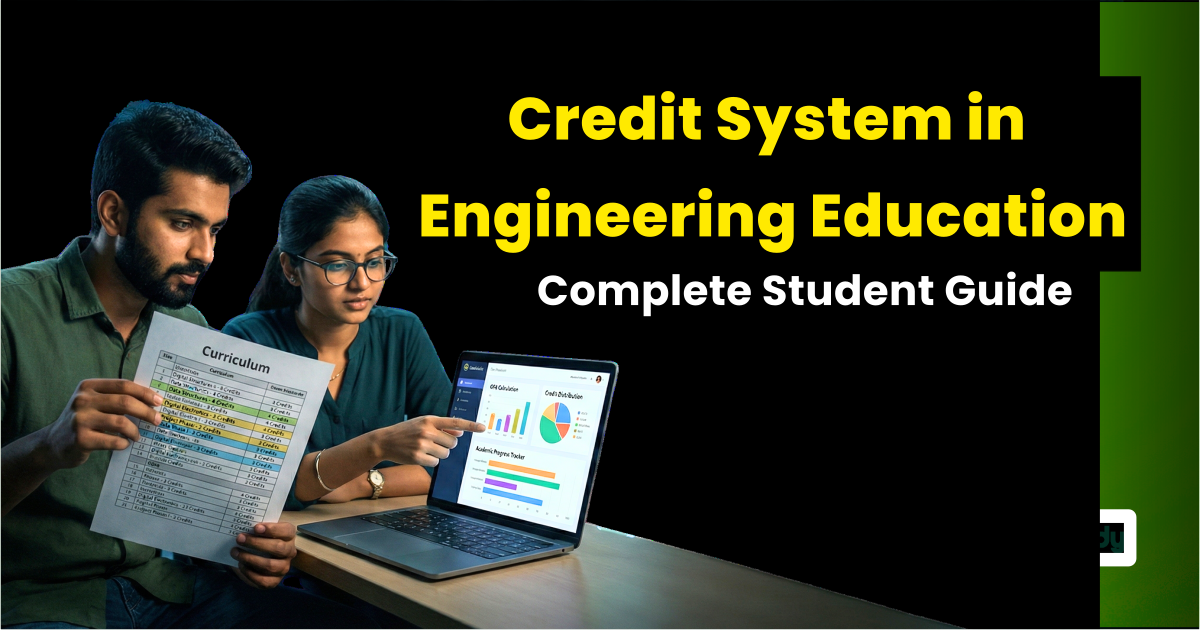
Key Highlights
The credit system in engineering education revolutionized B.Tech programs by quantifying learning workload across 160-180 credits over 8 semesters, enabling flexibility, transfers, and skill-focused outcomes under AICTE/UGC's Choice-Based Credit System (CBCS). Unlike rigid annual exams, credits measure lecture hours (1 credit/hour), tutorials (1 credit/hour), and labs (1.5-2 credits), helping Chennai TNEA students track progress toward engineering careers in CSE, Mechanical, or emerging AI fields while preparing for future engineering jobs demanding practical skills.
1. Fundamentals of Credit Allocation
1 credit = 1 hour of lecture/tutorial OR 2 hours of lab per week across 15-week semesters. Theory courses carry 3-4 credits; labs 1.5-2; projects 6-12. Total workload per credit: ~40 student hours (class + self-study).
Credit Types: Hard Core (branch compulsory), Soft Core (electives), Open Electives (interdisciplinary), Projects. Minimum 20 credits/semester required; maximum 28.
2. Semester-Wise Credit Distribution
Semesters 1–2
• Credits: 24 × 2 = 48
• Core Focus: Foundation subjects
• Example Subjects: Maths-I, Physics, C Programming (3 credits each)
Semesters 3–4
• Credits: 24 × 2 = 48
• Core Focus: Branch core subjects
• Example Subjects: Data Structures (4 credits), Digital Logic (3 credits)
Semesters 5–6
• Credits: 22 × 2 = 44
• Core Focus: Advanced subjects and electives
• Example Subjects: Operating Systems (4 credits), Computer Networks (3 credits), AI Elective (3 credits)
Semesters 7–8
• Credits: 20 × 2 = 40
• Core Focus: Projects and internships
• Example Subjects: Major Project (12 credits), Seminar (2 credits)
Total: 180 credits. Anna University mandates exact distribution; IITs offer flexibility.
3. Grading and CGPA Calculation
Letter Grades: O(10), A+(9), A(8), B+(7), B(6), C(5), D(4), E(0)—F fail. SGPA (Semester GPA) = (Σ Grade×Credits)/Total Credits. CGPA = Cumulative average.
Example: Maths(4cr,A=8), Physics(3cr,B+=7) → SGPA = (32+21)/7 = 7.57. Pass: SGPA ≥6. Backlogs cleared next semester; max 4-year completion.
4. Advantages of Credit-Based Learning
Flexibility: Choose electives (15-20% credits) aligning with best engineering fields—AI for CSE, Robotics for Mechanical. Credit banking allows semester breaks.
Transferability: Switch colleges mid-program (Anna to VIT) without credit loss. NEP 2020 enables multiple entry/exit: Certificate(40cr), Diploma(80cr), Degree(160cr).
Industry Alignment: Internships (6-12cr), MOOCs (Coursera credits) count toward degree.
5. Credit System Variations by College Type
Government (IITs/NITs): 20-25 credits/semester, research electives, summer term credits. Flexible audit courses.
Anna University Affiliates: Fixed 24 credits/semester, centralized syllabus, limited electives (university-approved list).
Deemed Universities (VIT/SRM): Fully flexible CBCS—pick from 100+ electives, rolling credits, industry projects integrated from Sem 3.
6. Student Strategies for Credit Mastery
Credit Planning: Map Sem 1-2 for 8+ CGPA base (40% weightage). Balance 6 theory + 2 labs weekly.
Elective Strategy: Sem 5+ pick high-weightage subjects matching placements (ML > Humanities). Max 2 electives/semester.
Backlog Management: Clear within 2 semesters; summer terms for overloads. Maintain 7.5+ CGPA for TCS/Wipro eligibility.
Credit Audit: Track via ERP portals (Anna Univ AU-FRO); aim 45/semester cumulative.
Pro Tips: Chennai students—leverage Sem 7 internships at Guindy IT corridor. Use credit calculators for graduation projections. MOOCs (NPTEL) earn 1-3 extra credits.
Credit banking under NEP supports working professionals returning for degrees. International transfers: 1 Indian credit ≈ 2 ECTS (Europe).
The credit system in engineering education transforms rigid syllabi into personalized learning paths, quantifying every lecture, lab, and project toward graduation. Master credit allocation, strategic electives, and CGPA management—your roadmap to engineering excellence and high-paying future engineering careers!
Explore colleges, courses, and admission details easily with Where2Study, your trusted education guidance platform. Get accurate, updated, and student-friendly information to make informed academic decisions. Start your career journey with confidence by choosing the right path through Where2Study.
Ready to Find Your Dream College?
Join 50,000+ students who found their perfect college
Book Free Counselling Now